Social Media Remix Abstract

For my personality test results, I got ESTP-T. This means that my mind is extraverted, my energy is observant, my nature is thinking, my tactics is prospecting, and my identity is turbulent. Overall, these results show that although I am outgoing and love being in groups of people externally, internally I am always focusing on ways to improve myself and I am very critical of myself while still remaining fairly emotionless about actions that come my way.

In my project, I want to curate for a future employer. I thought this would be an interesting audience as my personality is driven towards success and I work well in groups. I also think logically and do not let my emotions get in the way of the rational think to do. These are good traits to highlight for a future employer, so I want to curate my project for them.

Finally, the indented style of my project will be very simple yet colorful. I want to emphasize the external calmness and logic of my personality trait while maintaining the colorful and bold aspect of being an extravert. Additionally, I want my project stay simple, less personal, and more professional, as it is for a future employer rather than a family member or a group of friends who I am close with.

“Your Anonymous Browsing Data Isn’t Actually Anonymous” – Response

It is honestly very common that after shopping online to be on another website and social media and the same products I viewed or purchased will show up. This is a frequent thing that a lot of people notice, but do not quite understand.

Online shopping is much easier than going into a store and looking through everything. Companies like Amazon have almost made it a standard to just ship something to your house rather than driving to stores to find it. Because of this, most of my shopping I do online. The information that these companies get gives them the opportunity to have advertisements to show things that are similar or that other people have bought that I might like.

Even on Amazon, it is normal to add something to your cart and something will pop up underneath saying others who bought that product also bought this, and list multiple other things that they think I might like to buy. This gives them the opportunity to try and sell more of their products to others under the assumption that if many people are buying additional products along with the current one in their cart, that others will buy them as well.

This shows how when I purchase multiples of similar things, online advertisements can use this to target other people into showing them what they think they should buy. By using these cookies that everyone gives them permission to use, we are giving these companies access to our own data.

Data Visualization

Money too Tight to Mention

Recently, music artists have been claiming that they are not receiving enough money from streaming music services. Yet many of these streaming companies are making a loss. This graphic shows how much the streaming apps pay the music industry and if musicians could potentially earn minimum wage based on how many streams their songs get.

https://informationisbeautiful.net/visualizations/spotify-apple-music-tidal-music-streaming-services-royalty-rates-compared/

The graphic is divided up by 9 music services, all color coordinated, and the average artist revenue per pay. Then based on the total users and the amount that do not actually pay for the music service, it is determined how many plays are necessary for an artist to make minimum wage at $1,472.

This graphic is useful as it is easy to see how each of the music services are able to pay artists and roughly breaks down how much each company is losing due to their services.

I thought this graphic was interesting, because at first glance it is very aesthetically pleasing. The contrast of vibrant almost neon colors against a dark background makes it easy to look at and follow the data.

It is also interesting as it makes you wonder how many of these music companies are able to stay in business. Spotify for example, loses roughly $426 million annually, yet they pay artists on average one of the lowest amounts, $0.0044 per stream.

Spotify also has the second greatest number of total users and just over half pay for a subscription. This shows us that because more people are using this as a streaming service, more artists are getting plays, meaning that the mere $0.0044 per stream adds up to the $426 million annually lost.


Diversity in Tech

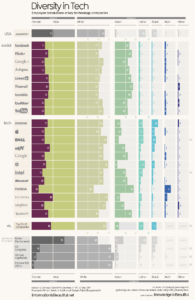
Diversity in any business is also a highly debated topic in which globally people are concerned that women and minorities are not accurately represented in large corporations, especially the tech industry which seems to be largely dominated by white males. In the graphic below, it breaks up how many top social media and tech companies are in terms of diversity of employees globally and even compares it with the US population, Kaiser Permanente (largest female employed US company), US Congress, Venture Capitalists, and Fortune 500 CEOs.
https://informationisbeautiful.net/visualizations/diversity-in-tech-static/

As seen above in the data, every single company is composed of a majority of white males, with the exception of NVIDIA where only 38% of the company is White and 44% is Asian, yet they also contain the lowest number of female employees at 16% (almost half that of every other company).

This graphic easily breaks down gender and ethnicity by company so it is very easy to decipher the demographic of each without necessarily reading the exact percentages.

Personally, I find this graphic interesting as a women who is interested in working in the tech industry, it is good to know what companies support female employees versus and company where I would see very little women representation.


WMD’s and the DIKW Model

In the introduction to the book Weapons of Math Destruction by Cathy O’Neil, O’Neil shares a story about fifth-grade teacher Sarah Wysocki. Wysocki had excellent reviews from administrators and her student’s parents, yet her IMPACT evaluation score was terrible causing her to be fired. The data from the IMPACT evaluation ranked teachers on how well they taught math and language through an algorithm.

Using the DIKW model it goes as follows:

DATA: Her IMPACT score was bad

INFORMATION: She is not efficient at teaching math and language

KNOWLEDGE: She is not a good teacher

WISDOM: She should be fired

The major issue with this is that there is no account for how well she actually is teaching her students. The IMPACT evaluations bases all of its scoring on how well her students are testing and what is to say that teachers from the previous year had inflated the grades in order to protect themselves. In addition, there is so much more that goes into being a good teacher rather than just how a student scores.

If a student is going through emotional duress during the year, would it not be more beneficial to have a teach who supports them at school rather than one who focuses on the test scores? For this reason, the IMPACT testing outcome is incorrect as it neglects to show other factors that go into a good teacher and fires the ones that are helping rather than the teachers that focus on test scores rather than supporting and educating students.

In the sixth chapter of the book “Ineligible to Serve,” O’Neil tackles the issue of WMD’s used for employers and hiring, specifically Kronos. In the case of Kyle Behm, a young man suffering from bipolar disorder at Vanderbilt University, Behm struggled to find work when returning to his education after a year and a half of treatment. His SAT scores had been nearly perfect and he attended an incredibly prestigious school, yet he was still being blocked from finding part-time minimum-wage jobs. This is due to the personality tests that many organizations use through Kronos in order to determine whether they should hire someone or not.

These “Five Factor Model” tests included questions to grade on traits such as “extraversion, agreeableness, conscientiousness, neuroticism, and openness to ideas” (106). The issue with this is that it discriminates against people who suffer from mental disabilities, but are still capable of working.

The DIKW model for these tests goes as follows:

DATA: Candidate answers yes to the question “Sometimes, I need a push to get started on my work”

INFORMATION: The candidate needs someone to tell them to work

KNOWLEDGE: The candidate is lazy

WISDOM: The candidate should not be hired

There are many issues with this model as the question is too ambiguous to be able to determine whether a person should be hired. For someone struggling with mental illness, it can take them a push to even get out of bed in the morning, but they still push themselves to do it it does not imply that they are lazy.

“What is Technology” – Stephen Kline

“I am making a point of saying ‘these systems’ and not just ‘hardware’ because nearly always we need more than just the hardware to create these extensions of human capacities” (Kline, 217).


This sentence adds more logic to the idea of what technology is. Often times, when defining technology, people will think of electronic developments to the world or major inventions to enhance cities and citizens lives. In reality, these ‘technologies’ would not be possible without the additional components to the hardware, thus making it a system. As stated in the article, with instruments, the knowledge of reading music and chords are still necessary to play. With a car, one must know how to operate the vehicle for it to be any use to them as means of transportation. In terms of technology, it truly is a system due to all of the components that make them work. From the idea, to plans, to manufacturing, to actually utilizing the technology, it becomes more than just the invention that makes the technology useful. Without each of these components, they would be useless, thus making them not technologies at all as they would not extend human capacities. So it is agreeable that the author makes this clarification that technologies are systems and not just merely hardware. It is definitely an unique perspective as the common thought of technology is just the final product itself, not all of the factors contributing to it.


Kline, S. J. (1985). What is Technology? Bulletin of Science, Technology & Society,5(3), 215-218.